
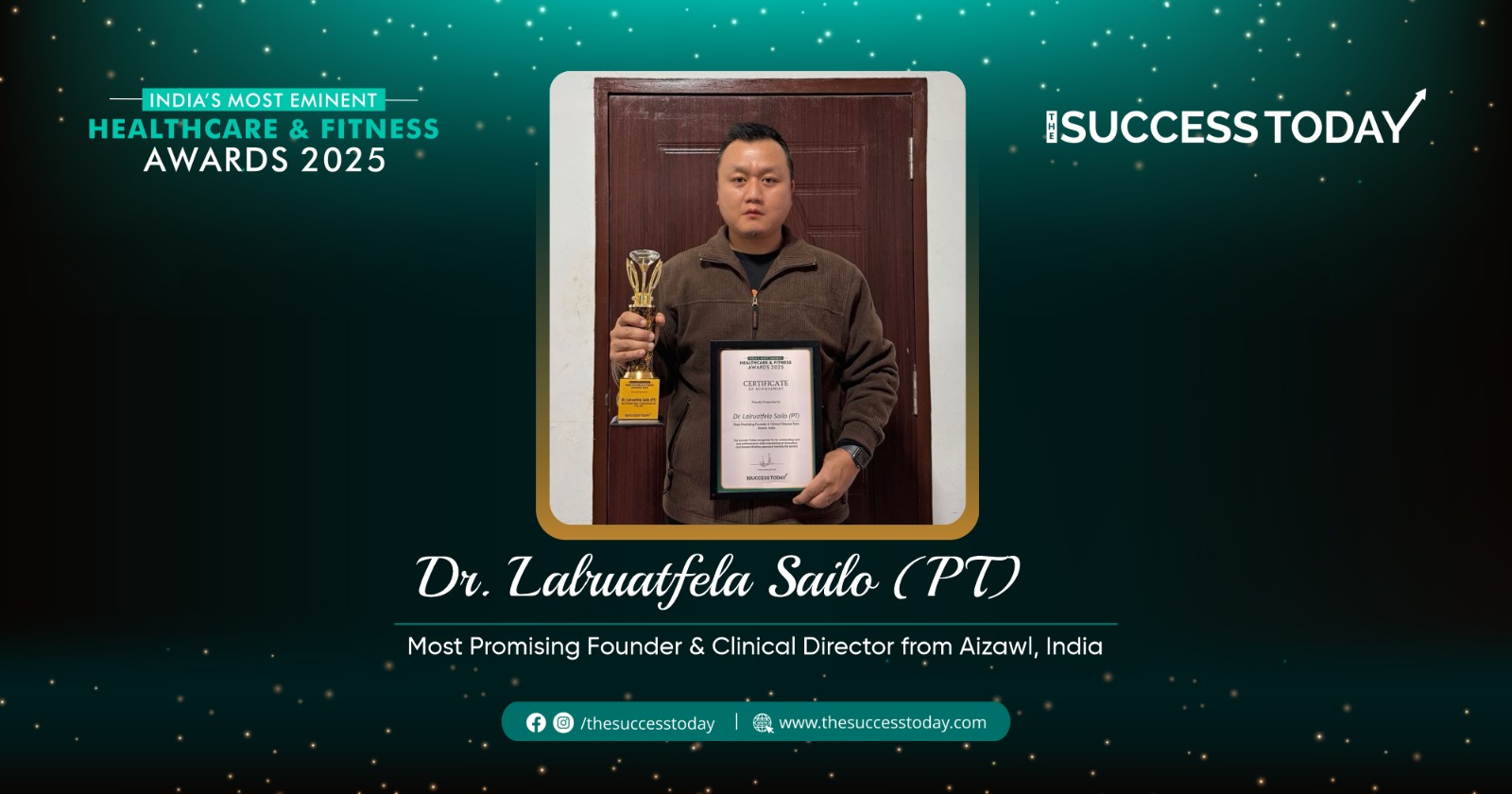
Interview by The Success Today
Could you tell us about yourself and your work?
I am Dr. Lalruatfela Sailo, PT, a physiotherapist and the Founder & Director of Samari Neuro-Rehabilitation & Physiotherapy Centre in Aizawl, Mizoram. I specialize in neurological and psychosomatic rehabilitation, with a clinical focus on spinal cord injuries, stroke recovery, chronic pain, and complex movement disorders.
My professional journey has been shaped by the need to bring structured, evidence-based rehabilitation closer to people, especially in regions where specialized neuro-rehabilitation services are limited. At Samari, my work involves designing individualized rehabilitation programs that emphasize functional recovery, neuroplasticity, and long-term independence rather than short-term symptom management.
In addition to clinical practice, I am actively involved in professional leadership and currently serve as the Secretary of the Physiotherapists’ Association of Mizoram, where I contribute to advocacy, professional development, and ethical standards in physiotherapy practice.
I strongly believe that recovery is a process that requires scientific knowledge, patience, and empathy. My approach to work is guided by the principle that movement is medicine, and when applied correctly, it can restore not just physical ability but also confidence and dignity in a person’s life.
How are you and your service helping society?
At Samari Neuro-Rehabilitation & Physiotherapy Centre, our primary contribution to society lies in restoring function, independence, and quality of life to individuals affected by neurological conditions, injuries, and chronic pain. Many of our patients come to us after life-changing events such as spinal cord injuries or strokes, often feeling uncertain about recovery. Through structured rehabilitation, we help them regain mobility, confidence, and a sense of purpose.
Beyond treatment, we place strong emphasis on patient education and awareness. By explaining recovery timelines, neuroplasticity, and the science behind pain and movement, we empower patients and caregivers to actively participate in the rehabilitation process. This reduces dependency, fear, and misinformation related to long-term disability.
Our service also plays an important role in strengthening specialized rehabilitation care in Mizoram. By establishing an inpatient neuro-rehabilitation unit and promoting evidence-based practice, we are raising the standard of care available locally.
Through professional associations and community outreach, we advocate early intervention, injury prevention, and ethical healthcare delivery. Ultimately, our work contributes to building a society that values movement, functional independence, and informed healthcare decisions.
What is the USP of your work?
The unique strength of my work lies in a holistic, neuroscience-driven approach to rehabilitation. At Samari, treatment is not limited to managing symptoms; it focuses on understanding the root cause of dysfunction and restoring meaningful movement through evidence-based physiotherapy.
Every patient receives a customized rehabilitation plan based on detailed clinical assessment, functional goals, and psychological readiness. This individualized approach ensures that therapy remains relevant, progressive, and effective. We place strong emphasis on neuroplasticity, task-specific training, and active participation, especially for neurological and chronic conditions.
Another important USP is addressing the mind-body connection, particularly in psychosomatic and chronic pain disorders. By combining physical rehabilitation with pain neuroscience education, we help patients understand their condition, reduce fear-avoidance behavior, and achieve long-term recovery.
Additionally, the availability of both outpatient and inpatient rehabilitation services allows for continuity of care, especially for patients requiring intensive and supervised programs. Our guiding philosophy—“Movement is Medicine”—reflects our commitment to ethical, scientific, and patient-centred rehabilitation
What are your Vision and Mission?
Vision:
My vision is to develop Samari Neuro-Rehabilitation & Physiotherapy Centre into a centre of excellence for neuro-rehabilitation in the North-East, where patients receive advanced, evidence-based care without needing to travel far from home. I envision a healthcare system where rehabilitation is accessible, ethical, and focused on long-term functional outcomes.
Mission:
My mission is to deliver high-quality, patient-centred rehabilitation that prioritizes functional independence, dignity, and sustainable recovery. I am committed to integrating current research, clinical expertise, and compassionate care into everyday practice.
An equally important part of my mission is education and awareness—for patients, caregivers, and young professionals—so that misconceptions surrounding pain, disability, and recovery are replaced with scientific understanding.
I also aim to contribute to the growth of the physiotherapy profession through leadership, advocacy, and ethical practice. Ultimately, my mission is to help people move better, live healthier lives, and believe in the possibility of recovery through structured and informed rehabilitation.
What are your achievements in this industry?
One of my significant achievements has been establishing Samari Neuro-Rehabilitation & Physiotherapy Centre and expanding it to include an inpatient neuro-rehabilitation unit, which has strengthened access to specialized rehabilitation services in Mizoram. This has enabled intensive, structured recovery programs for patients with spinal cord injuries, stroke, and complex neurological conditions.
Clinically, I have been privileged to support numerous patients in regaining mobility and independence, including individuals who were previously bed-bound or functionally dependent. These outcomes reflect the impact of evidence-based rehabilitation combined with patient commitment.
Professionally, serving as the Secretary of the Physiotherapists’ Association of Mizoram has allowed me to contribute to professional development, advocacy, and ethical practice within the physiotherapy community.
Receiving the India’s Most Eminent Healthcare & Fitness Award 2025 is an honour that acknowledges consistent effort, ethical practice, and service to society. However, my most meaningful achievement remains the trust placed in our work by patients and families and the positive changes rehabilitation brings to their lives.
Does your work ever feel tedious to you? If so, how do you stay driven and motivated towards it?
Rehabilitation work can be physically and emotionally demanding, especially when dealing with patients who require long-term care and patience. While the process can be challenging, it has never felt tedious or purposeless.
What keeps me motivated is witnessing small yet meaningful progress—a patient sitting independently, standing after months of immobility, or regaining confidence through movement. In rehabilitation, progress is gradual, but every improvement represents resilience and hope.
I also remain driven by continuous learning. Advances in neuroscience and rehabilitation techniques constantly reshape clinical practice, keeping the work intellectually engaging and purposeful.
Most importantly, patient trust is a strong source of motivation. Knowing that individuals and families rely on our expertise encourages me to approach each day with responsibility and dedication. For me, the impact of helping someone regain function and dignity outweighs the challenges, making the work deeply fulfilling.
What are your hobbies and specific interests other than your profession?
Outside my professional responsibilities, I have a strong interest in sports and community activities, particularly football. I actively support grassroots sports initiatives, as they promote discipline, teamwork, and physical well-being—values that align closely with my profession.
I also enjoy reading and writing, especially on topics related to neuroscience, health education, and lifestyle wellness. Creating educational content allows me to communicate scientific concepts in simple and practical ways, benefiting both professionals and the general public.
Community engagement and faith-based activities are also important aspects of my life. They help me stay grounded, socially connected, and mentally balanced.
These interests provide a healthy balance between professional commitment and personal well-being, reinforcing my belief that health extends beyond clinical settings into daily movement, purpose, and community connection.
You have achieved so much in life, any specific advice you’d like to share with our readers to grow in life.
My advice to readers is to focus on consistency rather than quick success. Growth in any field requires patience, discipline, and a willingness to learn continuously. Choose a path that genuinely adds value to others, because meaningful service naturally leads to long-term fulfillment and recognition.
Never stop upgrading your knowledge and skills, especially in a rapidly evolving world. At the same time, take care of your physical and mental health—success holds little value without well-being.
Embrace challenges and failures as learning opportunities rather than setbacks. Each obstacle provides insight that shapes resilience and character.
Finally, remain humble and ethical in your work. When effort is guided by integrity and purpose, success becomes a natural outcome rather than a constant pursuit.
Read more interviews:
Website : https://thesuccesstoday.com/
Instagram : https://www.instagram.com/thesuccesstoday
Facebook : https://www.facebook.com/thesuccesstoday
All the articles and posts published are gathered from various sources and other platforms. The founder and the writer do not hold any responsibility for the information held in the articles. No harm is intended in any means to anyone and doesn't aim to spread rumors or hatred to anyone whatsoever. Our articles do not substitute any financial, medical, or psychological professionals, whatever the readers pick up is solely upon themselves. We don't hold responsibility for any incident arising on account of any action taken based on the article. Our founders and writers disclaim all claims and suits of all sorts. Readers discretion is advised.