
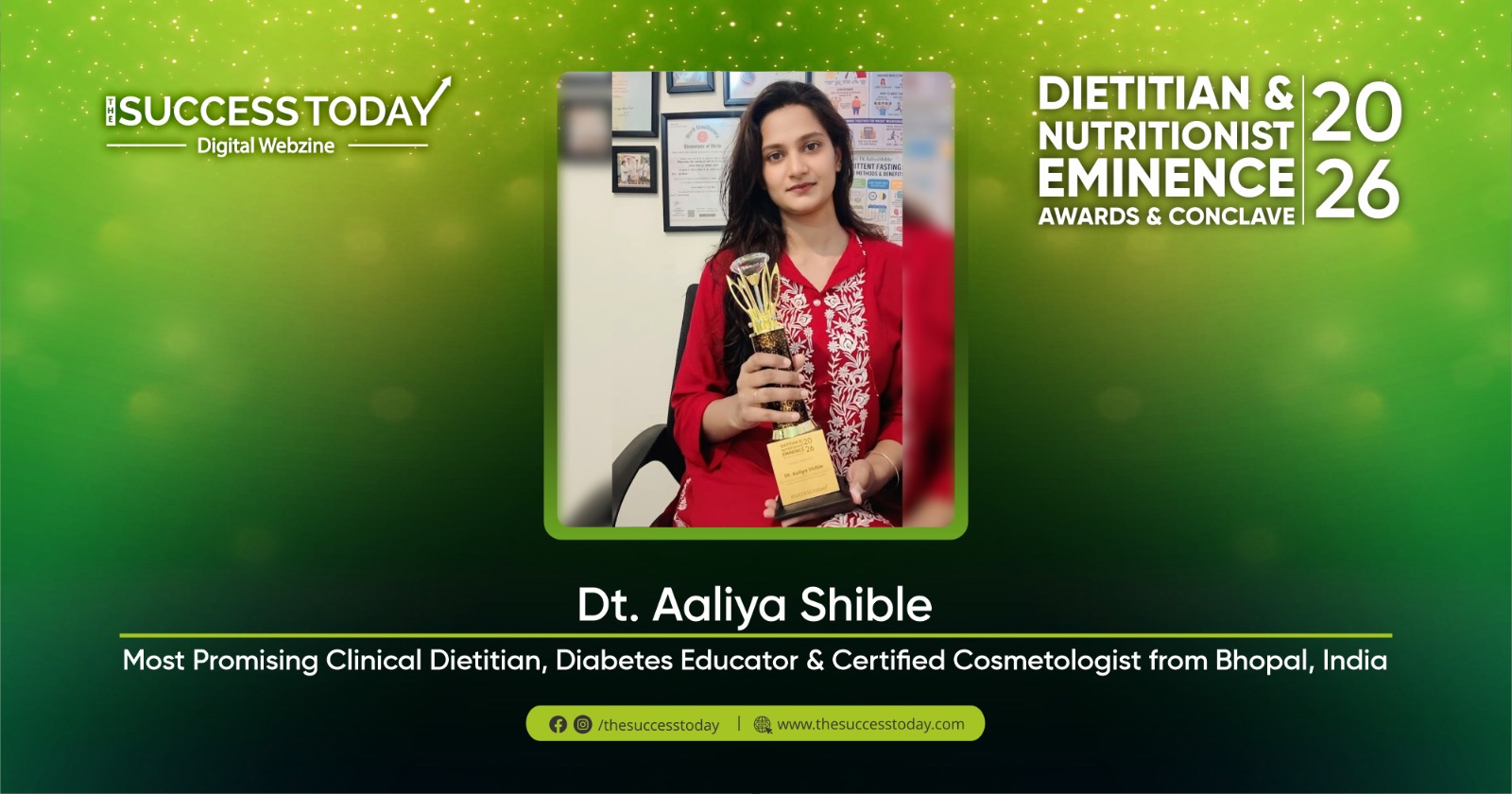
Interview by The Success Today
Could you tell us about yourself and your work?
I am Dt. Aaliya Shible, a Clinical Nutritionist and Certified Diabetes Educator. My journey in nutrition has been a combination of education, practical experience and continuous learning. Over the years, I have worked with people dealing with concerns such as weight management, PCOS, diabetes, thyroid disorders, cholesterol, fatty liver, pregnancy and postpartum nutrition, and other lifestyle-related issues.
For me, nutrition is not simply about giving someone a diet chart. Food is connected with our routine, family, work, stress, sleep, culture and financial situation. So, I try to understand the person first and then create a practical approach that they can actually follow.
I also believe that a nutritionist’s responsibility goes beyond weight loss. A person may lose weight and still feel tired, hungry or nutritionally deprived, which is not a successful long-term approach. My focus is on improving health while making food habits sustainable.
Alongside clinical nutrition and diabetes education, I have also pursued certification in cosmetology, which has expanded my interest in the connection between internal health and skin health.
My work is essentially about making nutrition understandable, practical and realistic rather than complicated or restrictive.
How you and your service is helping society?
One of the biggest problems I see today is not a lack of information, but an excess of confusing information. People are constantly exposed to crash diets, unrealistic weight-loss promises, social-media trends and advice that may not be suitable for their individual health conditions.
Through my consultations and educational work, I try to simplify nutrition and help people understand the reasoning behind their food choices. Whether someone is dealing with diabetes, PCOS, weight concerns, thyroid issues or simply wants to improve their lifestyle, I believe they should understand why a particular change is being recommended.
I also try to make my approach practical for ordinary households. Not everyone has the time or budget to prepare elaborate “healthy” recipes every day. A sustainable plan should be compatible with someone’s work schedule, family responsibilities, food preferences and existing lifestyle.
Another important part of my work is awareness. I use social media to discuss nutrition-related topics in a simple and relatable way so that people can identify misinformation and make more informed choices.
I don’t see nutrition as a punishment or a temporary diet. My aim is to help people develop habits they can continue even after their consultation or programme ends. That, in my opinion, creates a much more meaningful impact on society.
What is the USP of your work?
I would say the biggest USP of my work is practical, personalised nutrition without unnecessary complication.
There are many diet plans available today, but a plan only works if the person can realistically follow it. I therefore don’t believe in giving everyone the same template. Two people with the same diagnosis can have completely different routines, food preferences, working hours, stress levels and nutritional requirements.
During consultation, I try to understand these factors before designing an approach. I also focus on educating the client instead of making them completely dependent on a diet chart. If someone understands portions, meal combinations, protein, fibre, hydration and how different foods affect their condition, they gradually become capable of making better decisions themselves.
Another important aspect is sustainability. I don’t want a person to follow a highly restrictive plan for a few weeks and then return to their previous habits. The goal is to build something that can fit into their normal life.
My approach is also strongly based on Indian home food. Healthy eating doesn’t have to mean expensive ingredients, fancy recipes or imported “superfoods.” Sometimes the most effective changes are simple improvements in the food a family is already eating.
For me, successful nutrition is not about perfection. It is about creating realistic habits that produce meaningful results over time.
What are your Vision and Mission?
My vision is to contribute towards a healthier society where people understand nutrition well enough to make informed food choices instead of blindly following trends.
I want nutrition to become less intimidating. Many people think that eating healthy means completely changing their lifestyle, giving up their favourite foods or spending a lot of money on specialised products. I want to change that perception by showing people that good nutrition can be practical, culturally appropriate and achievable.
My mission is to provide evidence-based nutritional guidance while keeping the human side of healthcare at the centre. Every person has a different lifestyle, and therefore nutrition should not be treated as a one-size-fits-all solution.
I also want to focus strongly on preventive nutrition. Conditions such as diabetes, obesity, fatty liver, high cholesterol and several lifestyle-related disorders don’t appear overnight. Our everyday food choices, physical activity, sleep and lifestyle can play an important role in long-term health.
Another part of my mission is nutrition education. I want my clients and audience to understand the why behind recommendations rather than simply following instructions.
Ultimately, I would like my work to help people move from temporary dieting towards a healthier relationship with food and a lifestyle that they can realistically maintain for years.
What are your achievements in this industry?
I consider my biggest achievement to be the experience I have gained by working with people with different nutritional needs and seeing how personalised guidance can make a difference in their everyday lives.
My professional journey has included experience as a nutrition consultant as well as work in the corporate nutrition sector. These experiences taught me that nutrition counselling is not only about nutritional knowledge; communication, consistency, understanding client behaviour and building trust are equally important.
I have worked with clients dealing with concerns including weight management, PCOS, diabetes, thyroid disorders, cholesterol and other lifestyle-related issues. One thing I have learned from this experience is that every result has a different story behind it. Sometimes the achievement is a significant change in weight, while at other times it is better energy, improved eating habits, better consistency or a person becoming more confident about managing their condition.
I have also completed my certification as a Diabetes Educator and recently expanded my professional learning into cosmetology. This reflects my belief that a healthcare professional should continue learning rather than becoming comfortable with what they already know.
I don’t measure success only through awards or numbers. For me, a client who understands their health better and becomes capable of making healthier choices independently is also a very meaningful professional achievement.
Does your work ever feel tedious to you? If so, how do you stay driven and motivated towards it?
Yes, absolutely. I don’t think any profession is interesting every single day. Nutrition can sometimes become repetitive because many clients come with similar questions, similar struggles and similar expectations. There are also days when counselling, documentation, planning and professional responsibilities can feel mentally tiring.
What keeps me motivated is remembering that, although the nutrition concepts may sometimes be similar, the person sitting in front of me is not. Every individual has a different story, family environment, routine and relationship with food. Finding the right way to communicate with that particular person keeps the work interesting.
I also try not to stop learning. Nutrition is a constantly evolving field, and new research continues to change how we understand different conditions and interventions. Continuing education helps me stay curious and prevents me from working on outdated assumptions.
Another thing that motivates me is seeing small changes in clients. It doesn’t always have to be dramatic weight loss. When someone starts understanding their meals, becomes more consistent, manages their portions or gains confidence in handling their condition, that itself is rewarding.
I also remind myself that being tired of work occasionally doesn’t mean I have chosen the wrong profession. Sometimes it simply means I need rest, better boundaries and a little space away from work.
What are your hobbies and specific interests other than your profession?
Outside my profession, I enjoy spending time with my family and being involved in my children’s everyday activities. Family time is important to me because nutrition and professional life can easily become all-consuming if we don’t consciously create a balance.
I also have a strong interest in learning and exploring creative things. I enjoy working on content ideas, particularly finding simple ways to communicate useful information through social media. I find the creative side of communication interesting because knowing something is one thing, but explaining it in a way that people actually understand is another skill.
I am also interested in beauty and skincare, which is one of the reasons I pursued certification in cosmetology. I find the connection between nutrition, lifestyle and overall appearance particularly interesting. At the same time, I believe beauty should not be reduced to a particular appearance or body size.
I enjoy simple activities more than having a long list of elaborate hobbies. With professional responsibilities and family life, I have learned that hobbies don’t always have to be big projects. Sometimes reading, learning something new, creating content, spending time with family or simply getting some quiet personal time can be enough.
For me, maintaining interests outside work is important because it keeps life balanced and gives me an identity beyond my profession.
You have achieved so much in life, any specific advice you’d like to share with our readers to grow in life.
I would say: don’t compare your timeline with someone else’s.
We live in a time where we constantly see other people’s achievements, businesses, careers and lifestyles on social media. What we usually don’t see is the uncertainty, failures, financial pressure, family responsibilities and years of work behind those achievements.
My own journey has taught me that progress is rarely linear. There will be periods when things move quickly and other periods when you feel that you are standing still. That doesn’t necessarily mean you are failing.
I also believe that skill and consistency are more valuable than constantly chasing quick results. Whatever field you choose, become genuinely good at it. Keep learning, accept criticism and be willing to change when you realise something isn’t working.
Another important lesson is not to wait for perfect circumstances. If you keep waiting for more money, more time, more confidence or the perfect opportunity, you may never start.
At the same time, growth doesn’t mean sacrificing everything else. Success that comes at the cost of your health, relationships or peace of mind needs to be questioned.
Most importantly, don’t be afraid to start again. Changing direction is not always failure. Sometimes it is simply part of finding where you actually belong.
Read more interviews:
Website : https://thesuccesstoday.com/
Instagram : https://www.instagram.com/thesuccesstoday
Facebook : https://www.facebook.com/thesuccesstoday
All the articles and posts published are gathered from various sources and other platforms. The founder and the writer do not hold any responsibility for the information held in the articles. No harm is intended in any means to anyone and doesn't aim to spread rumors or hatred to anyone whatsoever. Our articles do not substitute any financial, medical, or psychological professionals, whatever the readers pick up is solely upon themselves. We don't hold responsibility for any incident arising on account of any action taken based on the article. Our founders and writers disclaim all claims and suits of all sorts. Readers discretion is advised.